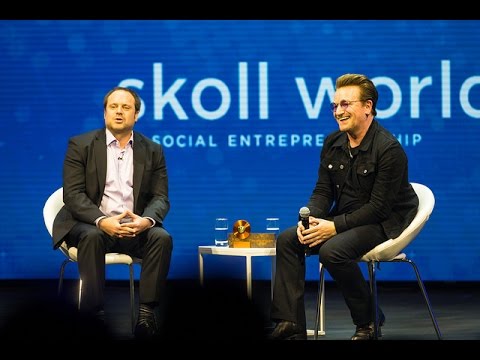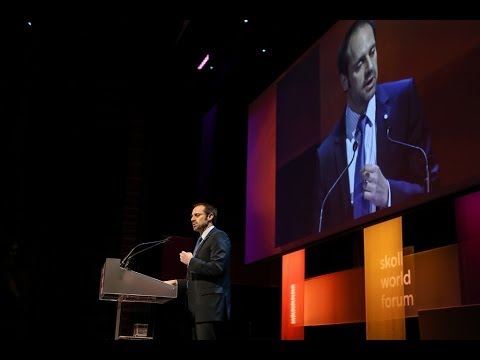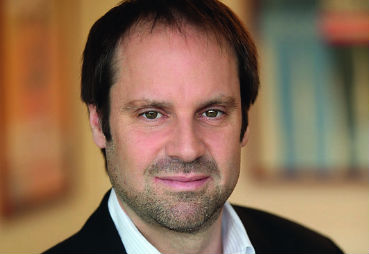
I've actually been waiting for, by the phone for a call from Ted for years. In fact in 2000, I was ready to talk about Ebay, but no call.
In 2003, I was ready to do a talk about school foundation and social entrepreneurship; no call. In 2004, I started Participant Productions and we had a really good first year and no call.
Finally, I got a call last year, and then I have to go up after J.J. Abrams. You've got a cruel sense of humor Ted.
When I first moved to Hollywood from Silicon Valley, I had some misgivings, but I found that there were some advantages to being Hollywood, and in fact have some advantages of owning your own media company. And also found that Hollywood and Silicon valley had a lot more in common than I would have dreamed.
Hollywood has it's sex symbols and the valley has it's sex symbols. Hollywood has it's rivalry's and the valley has it's rivalry's.
Hollywood gathers around power tables, and the valley gathers around power tables. So it turned out there is a lot more in common then I would have dreamed. But I'm actually here today to tell a story and part of it is a personal story.
When Chris invited me to speak, he said people think of you as a bit of an enigma and they want to know what drives you a bit.
And what really drives me is, is a vision of the future that I think we all share. It's a world of peace and prosperity and sustainability.
And when we heard a lot of the presentations over the last couple of days, Ed Wilson and the pictures of James Knockley I think we all realize how far we have to go to get to this new version of humanity that I like to humanity 2.0. And it, it's also something that resides in each of us, to close what what I think are the the two big calamities in the world today.
One is the gap in opportunity. This gap that President Clinton last night called uneven, unfair , and unsustainable.
And out of that comes poverty and illiteracy and disease and all these evils that we see around us, but perhaps the other bigger gap is what we call the hope gap. And someone at some point came up with this very bad idea that an ordinary individual couldn't make a difference in the world, and I think that's just a horrible thing .
And so, Chapter One really begins today with all of us, because within each of us is the power to equal those opportunity gaps and to close the hope gaps and if the men and women of TED can't make a difference in the world, I don't know who can.
And for me a lot of this started when I was younger and my family used to go camping in upstate New York. And there really wasn't much to do there for the summer except get beaten up by my sister or read books.
And so I used to read authors like James Michener and James Clavell and Ayn Rand. And, their stories made the world seem a very small and interconnected place.
And it struck me that if I could write stories that were about this world as being something small and inter-connected, that maybe I could get people interested in the issues that affected us all and maybe engage them to make a difference .
I didn't think that was necessarily the best way to make a living, so I decided to go on a path to become financially independent so I could write these stories as quickly as I could.
I then had a bit of a wake up call when I was fourteen and my dad came home one day and announced that he had cancer, and it looked pretty bad. And what he said was, he wasn't so much afraid that he might die but that he hadn't done the things that he wanted to with his life. And, knock on wood, he's still alive today many years later. But for a young man, that made a real impression on me, that one never knows how much time one really has.
So I set out in a hurry. I studied engineering. I started a couple of businesses that I thought would be the ticket to financial freedom. One of those businesses was a computer rental business called Micros on the Move, which was very well named because people kept stealing the computers.
So, I figured I needed to learn a little bit more about business. So I went to Stanford Business School and studied there. And while I was there, I made friends with a fellow named Pierre Omidyar, who is here today. And Pierre, I apologize for this photo from the old days.
And just after after I graduated, Pierre came to me with this idea to help people buy and sell things online with each other. And with the wisdom of my Stanford degree, I said, Pierre, what a stupid idea. And needless to say, I was right. But right after that Pierre, in '96, Pierre and I left our full-time job is to build Ebay as a company. And the rest of that story, you know, the company went public two years later, and is today one of the best known companies in the world.
Hundreds of millions of people use it in hundreds of countries and so on but for me, personally, it was a real change. I went from living in a house with five guys in Palo Alto and living off their leftovers, to all of sudden having all kinds of resources. And I wanted to figure out how I could take the blessing of these resources and share it with the world. And around that time I met John Gardner who is a remarkable man.
He was the architect of the Great Society programs under Lyndon Johnson in the 1960's, and I asked him what he felt was the best thing I could do, or anyone could do to make a difference in the long-term issues facing humanity, and John said bet on good people doing good things. Bet on good people doing good things.
And that really resonated with me. I started a foundation to bet on these good people doing good things. This leading innovative non-profit folks who are using business skills in a very leveraged way to solve social problems.
People today we call social entrepreneurs. And, to put a face on it. People, like Muhammad Yunus who started the Grameen Bank, has lifted 100 million people plus out of poverty. Won the Nobel Peace Prize.
There's also a lot of people that you don't know. Folks like Ann Cotton started a group called Camfed in Africa, because she felt girls education was lagging.
And she started at about ten years ago, and today she educates over a quarter million African girls.
And somebody like Dr. Victoria Hale, who started the world's first nonprofit pharmaceutical company, and whose first drug, will be fighting a visceral leishmaniasis, also known as black fever, and by 2010 she hopes to eliminate this disease which is really a scourge in the developing world.
And so this is one way to bet on good people doing good things. And a lot of this comes together in a philosophy of change that I find really is powerful. It's what we call invest, connect and celebrate.
And invest; if you see good people doing good things, invest in them, invest in their organizations, or in business, invest in these folks . Connecting them together through conferences like a TED brings so many powerful connections, or through the world forum in social entrepreneurship that my foundation does at Oxford every year.
And celebrate them. Tell the stories because not only are there good people doing good work, but their stories can help close these gaps of hope. And it was this last part of the mission, the celebrate part, that really got me back to thinking, when I was a kid , and wanted to tell stories to get people involved in the issues that affect us all.
And a lightbulb went off, which was first that I didn't actually have to do the writing myself. I could find writers.
And the next light bulb was better than just writing. What about film and TV to get out to people in a big way? And I thought about the films that inspired me, films like Ghandi and Schindler's List, and I wondered, who is doing these kind of films today? And there really wasn't a specific company that was focused on the public interest.
So in 2003 I started to make my way around Los Angeles to talk about the idea of a pro-social media company, and I was met with a lot of encouragement.
One of the lines of encouragement that I heard over and over was, the streets of Hollywood are littered with the carcasses of people like you who think you're going to come to this town and make movies.
And then, of course, there was the other adage, the surest way to become a millionaire is to start by being a billionaire and go into the movie business. undeterred in January 2004 I started participant production with the vision to be a global media company focused on the public interest, and our mission is to produce entertainment that creates and inspires social change.
We don't just want people to see our movies and say that was fun and forget about it. We want them to actually get involved in the issues.
In 2005, we launched our first slate of films: Murder Ball, North Country, Siriana, and Good Night and Good Luck. Much to my surprise, they were noticed.
We ended up with 11 Oscar nominations for these films, and in turned out to be a pretty good deal for this guy.
Perhaps more importantly tens of thousands of people people joined the advocacy programs and the activism programs that we created to go around the movies.
We have an online component of that our community site called participated.net, but with our social sector partners like the ACLU and PPS and the Sierra Club and NRDC. Once people saw the film, there was actually something they could do to make a difference. One of these films in particular, called North Country, it was actually kind of a box office disaster .
But, it was a film that starred Charlize Theron, and it was about women's rights, women's empowerment, domestic violence and so on. And we released the film at the same time that the congress was debating the renewal of the violence against woman act.
And with screenings on the hill, and discussions with our social sector partners, like the National Organization of Women, the film was widely credited with influencing the successful renewal of the act.
And that to me spoke volumes because it is the film started about the true life story about a woman who was harassed , sued her employer, led to a landmark case that led to the Equal Opportunity Act and the Violence Against Women Act and others.
And then the movie about this person doing these things then led to this great renewal. So, again it goes back to betting on good people doing good things.
Speaking of which, our fellow tedster Al. I first saw Al do his slide show presentation on global warming in may of 2005. At that point I thought I knew something about global warming.
I thought it was a 30 to 50 year problem, and after we saw his slide show, it became clear that it was much more urgent.
So, right afterwords I met backstage with with Al, and with Lawrence Bender who was there, and Laurie David, and Davis Guggenheim who was running documentaries for participant at the time.
With Al's blessing we decided on the spot to turn it into a film. Because we felt that we could get the message out there far more quickly than having Al go around the world speaking to audiences of a 100 or 200 at a time.
There is another adage in Hollywood that nobody knows nothing about anything, and I really thought that this was going be straight to PBS charitable initiative, and so it was a great shock to all of us when the film really captured the public interest. And today is mandatory viewing in schools in England and Scotland and most of Scandinavia.
We've sent 50,000 DVDs to high school teachers in the U.S. and its really changed the debate on global warming. It was also a pretty good year for this guy. We now call Al the George Clooney of Global Warming.
And for participant, this is just the start. Everything we do looks at the major issues in the world, and we have about ten films in production right now and dozens other in development.
I've quickly talk about a few coming up. One is Charlie Wilson's War with Tom Hanks and Julia Roberts. And and it's the true story of congressman Charlie Wilson and how he funded the Taliban to fight the Russians in Afghanistan.
And we're also doing a movie called The Kite Runner based on the book The Kite Runner And also about Afghanistan and we think once people see these films, they'll have a much better understanding of that part of the world, and the middle east in general.
We premiered a film called the "Chicago 10" at Sundance this year. It's based on the protesters at the Democratic Convention in 1968, that would be Hoffman and crew.
And again, a story about a small group of individuals who, who did make change in the world.
And a documentary that we're doing on Jimmy Carter and his Mid-East peace efforts over the years. And in particular we've been following him on his recent book tour, which as many of you know has been very noncontroversial which is really bad for getting people to come see a movie.
In closing I'd like to say that everybody has the opportunity to make change in their own way, and all the people in this room have, have done so through their business lives or their philanthropic work or or their other interest and one thing that I've learned is that there's never one right way to make change. Can do it as a tech person, or as a finance person, or a non-profit person, or as an entertainment person.
But every one of us is all of those things and more, and I believe if we do these things we can close the opportunity gaps, we can close the hope gaps. And I can imagine if we do this, the headlines in ten years might read something like these:
New AIDS cases in Africa fall to zero. U.S. imports its last barrel of oil. Israelis and Palestinians celebrate ten years of peaceful coexistence. Hey, and I like this one: Snow has returned to Kilimanjaro. And finally, an eBay listing for one well-traveled slideshow, now obsolete, a museum piece. Please contact Al Gore.
And I believe that working together, we can make all of these things happen, and I want to thank you all for having me here today.
It's been a real honour, thank you. Thank you.